
Desde lo básico hasta lo más exclusivo: Cómo los sistemas asépticos impulsan la próxima ola de crecimiento para los fabricantes de productos lácteos

Dairy siempre han sido una de las categorías más dinámicas del sector de la alimentación y las bebidas, abarcando desde productos básicos de consumo diario hasta caprichos gourmet y alimentos altamente funcionales.
Hoy en día, las verdaderas oportunidades de crecimiento residen en productos más exclusivos y diferenciados que ofrezcan un sabor excelente, un mayor valor nutricional y mayor comodidad.
Aquí es donde entra en juego la aseptic technology . Al combinar un proceso aséptico suave con un envasado aséptico avanzado, los fabricantes pueden crear productos de larga conservación que ofrecen una calidad similar a la de los productos frescos, protegen los ingredientes sensibles y van mucho más allá de la sección tradicional de productos refrigerados.
Julia Trebels es Directora Sénior de Categoría en el departamento de Marketing Global de SIG. Con más de 10 años de experiencia en el sector de la alimentación y las bebidas, está especializada en innovación de categorías, desarrollo de mercados y análisis del comportamiento de los consumidores. A Julia le apasiona colaborar con socios para crear soluciones innovadoras para las categorías y descubrir las principales tendencias del sector y de los consumidores que están marcando el futuro de los mercados de alimentos y bebidas en todo el mundo.
Sigue a Julia Trebels, de « Julia Trebels on LinkedIn

Para un responsable de la toma de decisiones del sector F&B, esto plantea una cuestión clave: ¿Cómo pueden los sistemas asépticos ayudarme a crear productos lácteos y bebidas de mayor calidad y valor añadido?
¿Por qué envasado aséptico? ¿Y por qué ahora?
En un mercado marcado por la volatilidad de las cadenas de suministro, los hábitos de consumo en constante evolución y las crecientes expectativas en materia de sostenibilidad, los sistemas asépticos se están convirtiendo en una de las palancas más poderosas para la resiliencia y el crecimiento rentable. ¿A qué se debe esto?
En pocas palabras, el procesamiento aséptico consiste en envasar productos esterilizados mediante tecnología UHT en envases igualmente esterilizados, dentro de un entorno completamente estéril. Esto permite obtener productos de larga vida que pueden almacenarse a temperatura ambiente durante meses, manteniendo su sabor y valor nutricional, sin necesidad de refrigeración ni conservadores.
Para los fabricantes de alimentos y bebidas, esto supone una serie de ventajas concretas:
- Sabor y valor nutricional constantes
El tratamiento térmico UHT de alta velocidad elimina los microorganismos nocivos. Después, el producto se enfría rápidamente y se envasa en condiciones estériles. Cada proceso se adapta al tipo de producto y a su formulación —ya sean lácteos, jugos o bebidas con partículas— para conservar su sabor, textura, apariencia y nutrientes. - Estabilidad de almacenamiento sin cadena de frío
Los productos envasados de forma aséptica pueden almacenarse, transportarse y comercializarse a temperatura ambiente. Esto reduce la dependencia de la cadena de frío y abre nuevas vías y mercados - Menores costos logísticos y mayor alcance
La ausencia de refrigeración, de almacenes y camiones con control de temperatura, así como una vida útil más prolongada, reducen los costos y la complejidad logísticos, especialmente en mercados donde la cadena de frío es limitada o costosa - Reducción del desperdicio alimentario
. Una mayor vida útil y una protección eficaz del producto reducen el desperdicio en el comercio minorista, la restauración y el ámbito doméstico. El alto nivel de consumo del producto (especialmente en formatos asépticos de «bag-in-box») hace que se consuma realmente una mayor cantidad de producto.
Por eso, el procesamiento y el envasado asépticos se adaptan perfectamente a tendencias como:
- Bebidas funcionales y ricas en proteínas
- Bebidas fermentadas, como los yogures líquidos y las bebidas tipo kéfir
- Fórmulas bajas en azúcar que se basan en perfiles de sabor cuidadosamente protegidos (como los purés de frutas y verduras para niños)
- Sistema inmunitario, salud intestinal & bebidas energéticas para el bienestar en formatos pequeños y prácticos
- Aperitivos líquidos saludables, sabrosos y prácticos, desde mezclas de café listas para tomar hasta batidos de proteínas

Optar por lo aséptico no consiste simplemente en cambiar el formato del envase. Se trata de una decisión sistémica que afecta a la formulación del producto, el procesamiento, las líneas de envasado, el servicio y los datos. SIG es un socio que ha creado una de las gamas de sistemas asépticos más amplias del sector del envasado, lo que garantiza que todos estos parámetros funcionen a la perfección de forma conjunta.
- Décadas de experiencia especializada
SIG cuenta con más de 170 años de tradición industrial, 120 años de experiencia en el envasado de alimentos y bebidas, y unos 50 años dedicados al envasado aséptico de alimentos y bebidas. - Una gama única de soluciones asépticas
SIG es el único proveedor global que ofrece soluciones de sistemas asépticos para envases de cartón, pouches con tapa y bag-in-box. Esto proporciona a los fabricantes un amplio abanico de opciones: tipos de envases, formatos, volúmenes, así como materiales y estructuras, equipos de llenado aséptico y servicios técnicos y digitales. - Enfoque centrado en el rendimiento a nivel de sistema
Desde la ciencia de los materiales hasta las formulaciones de productos, pasando por la tecnología de llenado y los servicios digitales, SIG se centra en optimizar el rendimiento de todo el sistema, no solo de los componentes individuales.
En la práctica, esto significa que los clientes de SIG del sector A&B reciben apoyo en:
- Adaptar cada producto y cada ocasión de consumo a la solución de envase adecuada
- Sistemas de llenado que destacan en múltiples aspectos: flexibilidad, velocidad, eficiencia y tiempo de funcionamiento, entre otros
- Integración del servicio técnico y la optimización basada en datos en las operaciones diarias de la planta
"El envasado aséptico aporta valor en múltiples aspectos: calidad, accesibilidad, eficiencia y prevención de residuos. Las implicaciones son significativas: menores costos logísticos, mayor acceso de los consumidores en mercados con una infraestructura de cadena de frío limitada y reducción del desperdicio alimentario."
Sistemas de envases de cartón aséptico: la columna vertebral de muchas gamas de productos a temperatura ambiente
Para muchos fabricantes de productos A&B, los envases de cartón asépticos constituyen la columna vertebral de sus gamas de productos a temperatura ambiente.
Las líneas compactas de llenado aséptico de envases de cartón de SIG están diseñadas para garantizar la seguridad y la calidad de los alimentos, así como el cumplimiento de las normas más estrictas de higiene alimentaria, al tiempo que se adaptan a las condiciones reales de producción. Parámetros como la velocidad, los tiempos de cambio de formato, la precisión de llenado, las tasas de merma y la compatibilidad con la automatización son tan importantes como el costo de los materiales, la compatibilidad con la cadena de suministro, los datos de consumo y las consideraciones de sostenibilidad: todos ellos determinan el rendimiento global y la facilidad de uso.

Entre las principales ventajas se incluyen:
- Máximo nivel de flexibilidad en cuanto a formato, volumen, diseño y tipo de producto
- Alta velocidad y tiempo de actividad
- Cambios rápidos en cuestión de minutos, lo que permite una gestión ágil de los productos
- Tasas de merma excepcionalmente bajas: menos del 0,5 %
La combinación con formatos de cartón modernos y prácticos convierte a los sistemas de cartón asépticos en plataformas versátiles tanto para los productos principales como para el lanzamiento de novedades.
Pouches con tapa: comodidad y nuevas formas de consumo
A medida que los consumidores demandan cada vez más opciones para llevar, que se puedan dividir en porciones y que sean aptas para snacks, los pouches asépticos con tapa están abriendo nuevas posibilidades para la innovación de productos.
Basándose en 50 años de experiencia en el llenado aséptico de envases de cartón, SIG ha trasladado sus conocimientos técnicos en materia de asepsia a los spouted pouches . Un hito importante lo constituye el aseptic spouted pouch, con esterilización en línea. Esto elimina la necesidad de que terceros se encarguen de la esterilización previa de los pouches y supone un cambio radical en la tecnología de los pouches asépticos.
El sistema ofrece a los fabricantes:
- Alto rendimiento: hasta 55 pouches por minuto
- Menor costo total de propiedad (TCO): la esterilización en línea simplifica el proceso y reduce los costos operativos
- Una amplia gama de volúmenes de envase: desde 30 ml hasta 500 ml, que abarca porciones infantiles, envases para adultos para llevar y formatos más grandes para llevar a casa.

El resultado es una mayor vida útil, una mayor flexibilidad en la formulación y formatos prácticos que resultan especialmente adecuados para:
- Bebidas lácteas y de origen vegetal para niños
- Productos diseñados para un estilo de vida activo y la nutrición deportiva
- Los hábitos actuales a la hora picar entre horas, que exigen facilidad para llevárselos y control de las porciones
"En el caso de los pouches con tapa, el paso a la tecnología aséptica cambia radicalmente las posibilidades. Abre nuevas líneas de productos y nuevas oportunidades comerciales."
Ya sea para el comercio minorista o para el sector de servicios de alimentos, los pouches de SIG están diseñadas para ofrecer una solución resistente, segura, confiable y fácil de usar.
Envase aséptico «bag-in-box»: previsibilidad, rendimiento y sostenibilidad
Entornos de servicios de alimentos —desde restaurantes de comida rápida y cadenas de cafeterías hasta comedores— se ven sometidos a una intensa presión para ofrecer una calidad constante con una mano de obra limitada y unos márgenes ajustados. Las soluciones asépticas de «bag-in-box» (BIB) de bag-in-box (BIB) proporcionan a los operadores y fabricantes una herramienta eficaz para gestionar esa complejidad.
SIG cuenta con una larga trayectoria de innovación en este ámbito:
- En la década de los 80, desarrolló el primer sistema aséptico BIB para productos de baja acidez, lo que abrió nuevas posibilidades para el sector lácteo.
- Esto permitió la conversión de productos como la leche, la mezcla para helados y las cremas para café al formato BIB, lo que supuso mejoras en materia de desperdicio alimentario, rentabilidad y sostenibilidad.
- Con el paso del tiempo, SIG amplió estas soluciones con la gama de accesorios Connect, lo que permite a los restaurantes de comida rápida elaborar bebidas mezcladas, como batidos y frappés, con solo pulsar un botón.
En la actualidad, junto con el llenado aséptico, los sistemas BIB de SIG se utilizan ampliamente en restaurantes de comida rápida, cadenas de cafeterías y entornos de dispensación. Ofrecen:
- Dosificación controlada y mínimo desperdicio de producto
- Calidad estable del producto durante largos periodos de tiempo
- Elevada relación entre producto y embalaje: se incluye una gran cantidad de producto con una cantidad mínima de material
- En la mayoría de los casos, se vacía más del 99 % del producto, independientemente de su viscosidad, ya que la bolsa se colapsa a medida que se dosifica el producto
- Protección contra la entrada de oxígeno, gracias al diseño del envase y del conector, lo que garantiza el sabor y la vida útil hasta la última gota

La flexibilidad en el volumen de los envases ofrece a los clientes un valioso acceso a múltiples canales de venta, desde el comercio minorista hasta la restauración y el procesamiento industrial.
"En el sector de la restauración, cada detalle cuenta. El sistema aséptico «bag-in-box» aporta previsibilidad y fiabilidad a las operaciones diarias."
El embalaje como parte del producto y del modelo de negocio
En este contexto, el envase ya no puede considerarse un aspecto secundario. Un concepto de éxito en el sector de la alimentación o las bebidas integra el envase desde el principio.
Por parte del consumidor, las señales visuales y táctiles —la forma, el color y el tacto de la superficie— son las que impulsan la primera compra, mientras que la portabilidad, la posibilidad de volver a cerrar el envase, la comodidad del agarre y la facilidad de uso influyen en la repetición de la compra. El envase transmite la funcionalidad, la adecuación al estilo de vida y los valores de la marca en cuestión de segundos.
Del lado del fabricante, el concepto del producto debe ajustarse a las limitaciones del mundo real:
- Velocidad de la línea de producción, flexibilidad y compatibilidad con la automatización
- Tiempos de cambio
- Precisión en el llenado y índices de desperdicio
- Costo de los materiales y resiliencia de la cadena de suministro
- Requisitos de sostenibilidad
Una tendencia de producto solo se convierte en un negocio viable y escalable cuando el producto, el envase y las operaciones se diseñan de forma conjunta. Los sistemas asépticos —ya sea en envases de cartón, pouches o BIB— son herramientas clave para hacer realidad esa integración.
Desde la elección de la tecnología hasta la estrategia de cartera: el SIG Category Game Board™
Una cosa es decidir invertir en tecnología aséptica. Otra cuestión estratégica es: ¿dónde deberían los fabricantes de alimentos y bebidas (F&B) aplicar exactamente esa capacidad en su cartera de productos, en las distintas ocasiones de consumo y en los distintos canales?
El SIG Category Game Board™ está diseñado precisamente para responder a esa pregunta. Se trata de una herramienta práctica y visual que ayuda a los fabricantes a analizar su cartera de productos e identificar de forma sistemática los «espacios en blanco» que ofrecen oportunidades de crecimiento.
¿Qué hace el Game Board?
El SIG Category Game Board™ es un mapa estructurado de las oportunidades por categorías y ocasiones. No sustituye a los análisis detallados del tamaño del mercado, los estudios de consumo ni el trabajo de estrategia de marca. En cambio:
- Ofrece a los equipos multifuncionales una visión común sobre dónde buscar oportunidades de crecimiento y qué combinaciones priorizar
- Muestra claramente dónde está presente la marca —y dónde no—
- Destaca un conjunto manejable de hipótesis sobre los espacios en blanco para el crecimiento, muchas de las cuales pueden ponerse en práctica o acelerarse mediante el envasado aséptico
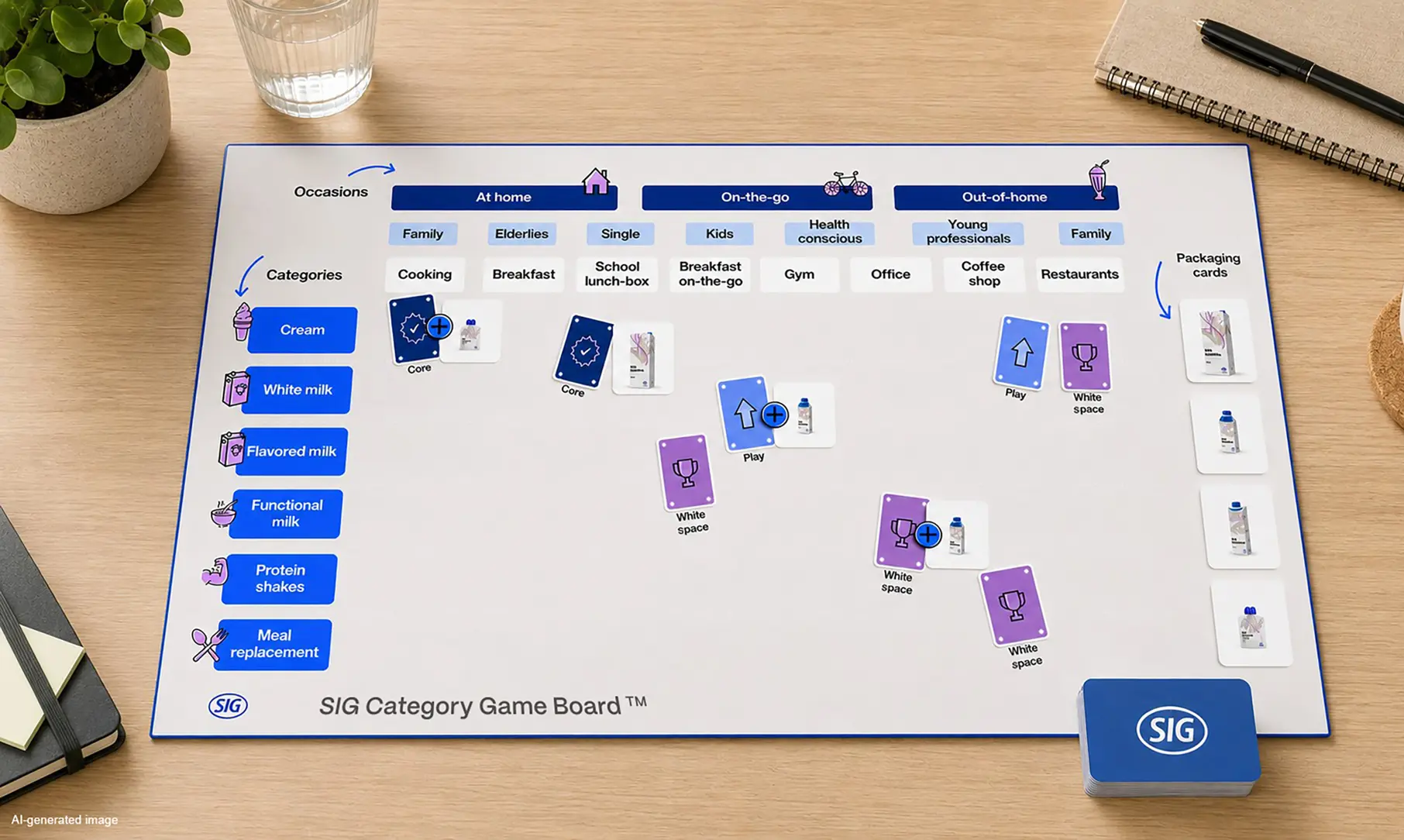
Para ello, analiza cuatro dimensiones fundamentales:
- Categorías - lo que vende una marca
Por ejemplo: leche entera, leche saborizada, bebidas de origen vegetal, crema culinaria, leche condensada, mix para helado, bebidas de yogur, queso untable, postres y mucho más - Ocasiones: cuándo y dónde se consume un producto
En casa, fuera de casa, en el trabajo, en el propio local de restauración o mediante entrega a domicilio o para llevar - Grupos destinatarios: a quién va dirigido el producto (por ejemplo, familias, niños, consumidores activos, operadores del sector de la restauración)
- Canales: lugares donde se compra, se sirve o se consume el producto
En casa, en el colegio, en la oficina, en un restaurante, en tiendas de conveniencia, etc. - Soluciones de envasado y tecnología: ¿cómo se consigue?
Por ejemplo, utilizando envases de cartón asépticos, pouch con tapa o envases «bag-in-box» para que una combinación concreta de categoría, ocasión y canal resulte viable tanto desde el punto de vista técnico como económico.
Al representar gráficamente las referencias existentes en función de estas dimensiones, los fabricantes pueden ver al instante qué "cartas" del tablero ya se han jugado, y cuáles quedan por colocar.
¿Por qué es importante específicamente para el envasado aséptico?
El crecimiento de «&» suele deberse a tres tipos de movimientos:
- Ampliación a nuevas situaciones de uso: por ejemplo, pasar de utilizar un producto básico en casa a consumirlo fuera de casa o en el trabajo
- Ampliar la oferta a categorías adyacentes o nuevas; por ejemplo, pasar de la leche natural a las leches saborizadas, los shots funcionales o las bases culinarias
El «Game Board» hace que estas opciones sean tangibles y ayuda a los equipos a plantearse lo siguiente: si contamos con capacidad aséptica —en cartón, en pouch o en BIB—, ¿en qué otros ámbitos podríamos actuar de forma creíble? En muchos casos, la barrera de entrada no es la demanda de los consumidores, sino la ausencia de una solución adecuada de envasado y de sistema.
Al superponer la gama de productos asépticos de SIG sobre el tablero de juego, los fabricantes pueden ver:
- ¿Qué nichos de mercado resultan atractivos una vez que se plantean formatos de consumo habitual y de larga conservación?
- : los nuevos soportes de envasado (como los spouted pouch o los envases BIB) abren nuevas oportunidades para el consumo sobre la marcha, los snacks o la restauración que los formatos refrigerados no pueden cubrir de forma eficiente
- Cómo equilibrar, de forma estructurada, el negocio principal (defensivo) con la innovación impulsada por el embalaje (ofensiva)
Un método sencillo y reproducible para detectar espacios en blanco
SIG recomienda seguir un procedimiento de seis pasos para aplicar el SIG Category Game Board™:
- Definir el panorama
.Define las categorías, ocasiones de consumo, públicos objetivo y canales que estarán dentro del alcance. Además, establece una taxonomía común que permita a todos hablar el mismo lenguaje. - Representa gráficamente la cartera actual
. Sitúa todos los productos actuales en el tablero. Marca dónde la marca es fuerte (núcleo) y dónde ya está presente. Esto crea un punto de partida basado en datos. - Identifica los espacios en blanco
Identifica combinaciones atractivas aún no aprovechadas, como oportunidades en canales, ocasiones de consumo, categorías adyacentes, nuevos o segmentos de consumidores adicionales, así como opciones de envasado (por ejemplo, pasar de productos refrigerados a productos de larga vida mediante el envasado aséptico). - Generar iniciativas
. Para cada nicho de mercado prioritario, desarrollar entre dos y tres conceptos iniciales —nuevos productos, ampliaciones de gama o innovaciones en el envase o el formato—, a menudo en combinación. - Evaluar y priorizar
. Evaluar cada concepto en función de su alineación estratégica, el valor que aporta al consumidor, su viabilidad y la rapidez con la que puede llegar al mercado. Finalmente, definir una hoja de ruta priorizada para su implementación. - Aprende, amplía y actualiza
. Pon en marcha proyectos piloto, realiza un seguimiento de los KPI, amplía lo que funciona y actualiza periódicamente el tablero. Con el tiempo, se irán ocupando más «casillas» a medida que los espacios en blanco se conviertan en negocios reales.
De este modo, las capacidades asépticas dejan de ser un activo puramente técnico para convertirse en un motor estratégico de crecimiento.
La colaboración como la próxima frontera de la innovación en el sector F&B
De cara al futuro, la próxima fase de la innovación en el sector de las bebidas «F&B» dependerá no solo de la tecnología, sino también de una colaboración más estrecha entre productores, minoristas y proveedores de soluciones asépticas.
"Cuando el desarrollo de productos, el envasado y los equipos se integran en una fase más temprana del proceso, los resultados son más sólidos y escalables. Así es como el sector llega a soluciones que funcionan a largo plazo: para las personas, para los mercados y para el planeta."
A medida que el sector lácteo y el sector F&B en general continúa evolucionando, el envasado a nivel de sistema —especialmente el envasado aséptico— está llamado a desempeñar un papel cada vez más relevante. Gracias a su portafolio en constante expansión y a su amplia experiencia en envases de cartón asépticos, bolsas con boquilla (spouted pouches) y sistemas bag-in-box, SIG está preparada para seguir siendo un socio estratégico para los fabricantes que ven el envasado aséptico no solo como una opción de envase, sino como una forma de impulsar nuevos productos, crear nuevas ocasiones de consumo, acceder a nuevos canales y descubrir nuevas oportunidades de crecimiento sostenible y rentable.