How refreshers became the biggest beverage opportunity
In May 2026, McDonald’s released a new line of craft beverages, including three flavors of refreshers. Refreshers—a category of fruit-forward, non-carbonated beverages typically made with tea, lemonade, or juice bases—have quietly become one of the fastest-growing beverage platforms in foodservice.
Caleb Bryant serves as the North America Category and Insights Manager at SIG, where he helps translate consumer, product, and market signals into actionable growth strategies. He works across both CPG food and beverage and foodservice industries, identifying key trends shaping category performance and uncovering opportunities for innovation and expansion. His work helps bridge data and decision-making, enabling SIG and its business partners to stay ahead in a rapidly evolving marketplace.

How refreshers are entering the mainstream
The arrival of refreshers at the world’s largest QSR chain could push the already fast-growing category to entirely new heights, bringing a beverage long popular with younger consumers to a much broader audience while motivating other chains to introduce their own takes on the highly trendy drinks.
The story of refreshers is one of an overnight success more than a decade in the making. More importantly, it demonstrates the market opportunity created when multiple consumer trends collide at the right moment.
How refreshers address menu gaps
Starbucks debuted refreshers in 2012 after identifying a menu white space for refreshing, non-coffee afternoon beverages. Since then, the refreshers platform has evolved into a pillar of Starbucks’ beverage business, with annual refresher sales surpassing $2 billion1. Dunkin followed with its own refreshers in 2020, and the drinks quickly became a major growth driver for the chain. Scott Murphy, Chief Brand Officer at Inspire Brands, noted that "Refreshers have been the single largest contributor to our incremental sales growth over the last couple of years.1” Dunkin has since expanded the platform with new flavors and functional twists, including a Cherry Protein Refresher featuring 15g of protein launched in 2026.

Why refreshers aren’t just for QSRs
Refreshers are also rapidly moving beyond coffee and beverage chains into new foodservice segments. From FSRs like Outback Steakhouse and PF Chang’s to QSRs such as Sonic Drive-In and even c-stores, the category’s expansion highlights both its broad appeal and operational versatility across venues. According to Datassential’s LTO database, there were already more refresher launches in the first half of 2026 than during all of 20252.
Why Gen Z is driving refresher growth
So what’s driving the ascent of a beverage format that has existed for over a decade, but only became a major industry focal point in the past three to four years? In short: Gen Z. Refreshers align closely with Gen Z beverage preferences and underscore the important role drinks play in younger consumers’ foodservice occasions.
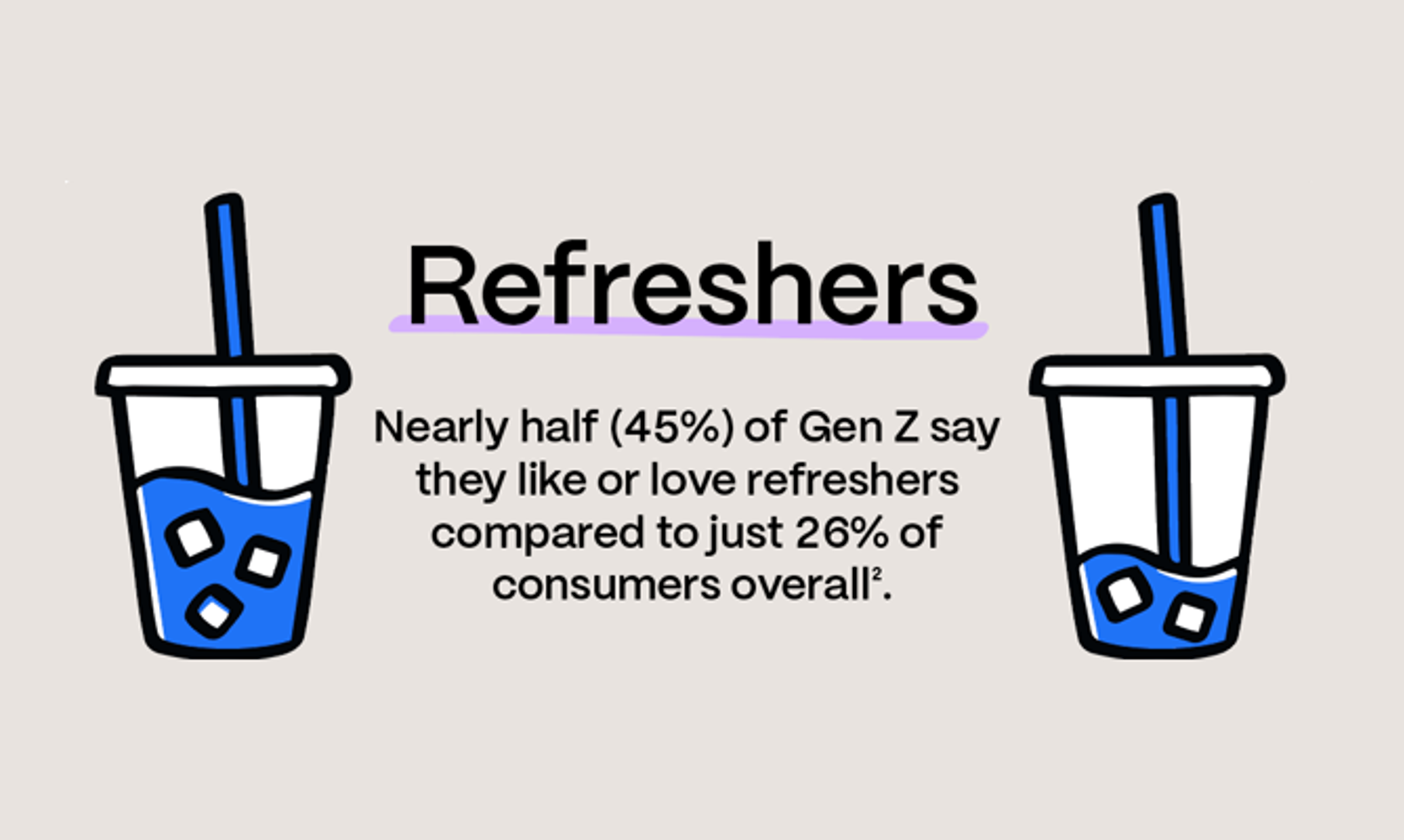
Beverages increasingly act as traffic drivers among Gen Z consumers, with 53% saying they look forward to signature non-alcoholic beverages when visiting foodservice venues4. Refreshers hit the mark for the generation thanks to their vibrant colors, fruit-forward flavor profiles, and non-carbonated format. Nearly half (45%) of Gen Z say they like or love refreshers compared to just 26% of consumers overall5.
How refreshers benefit operators
Refreshers are not only resonating with younger consumers, they also check several important boxes for operators. Refreshers represent a high-margin platform that can attract Gen Z and Gen Alpha consumers while helping chains expand into afternoon beverage occasions. At the same time, the format’s relatively loose definition allows operators to leverage ingredients they already stock, including teas, lemonades, flavored syrups, fruit inclusions, and functional add-ons. Among operators currently offering refreshers, 54% report increased refresher sales versus a year ago4.
"While refreshers have already become a mainstream menu item at leading restaurant chains, the category remains in its early stages of adoption. Refreshers appear on fewer than 2% of restaurant menus, and only one-third of consumers report ever trying one—highlighting substantial room for future growth."
What are global refresher opportunities?
Not only are refreshers a US foodservice opportunity, the trendy drinks face an opportunity to go global. While much of the early momentum has been in US coffee chains, the refreshers playbook appeal to global consumer trends and dynamics such as:
- A younger generation that is digitally native, brand savvy, and constantly sharing visuals
- A growing desire for non alcoholic, flavorful, “anytime” beverages
- Increased focus on lighter, more refreshing options in warmer climates and urban markets

For operators outside the US, the exact flavor profiles may differ—mango lychee in Southeast Asia, hibiscus citrus in Latin America, perhaps yuzu or matcha combinations in Japan—but the core opportunity is similar: a high margin, differentiated, cold beverage platform that resonates strongly with younger consumers.
What’s next for refreshers?
As more chains launch their own refreshers, what does that mean for Starbucks, the category’s original pioneer? Expect continued innovation, new flavors, and more functional variations. In 2026, Starbucks introduced Energy Refreshers, a highly caffeinated spin on the traditional format. As CEO Brian Niccol told analysts, “It’s almost a compliment that our Refresher business is being imitated in so many places3.”
Why SIG bag-in-box for refreshers?
As refreshers scale across foodservice, operators face a common challenge: delivering consistent beverage quality while maintaining speed of service and attractive margins. Packaging plays an increasingly important role in solving that challenge.
"That’s where SIG bag-in-box (BIB) systems enable improved performance across the value chain. SIG bag-in-box packaging is designed to preserve the flavors, colors, and functional ingredients that define today’s refresher beverages."
High-barrier films help to maintain product integrity from fill through dispense, ensuring consistent consumer experience. At the same time, bag-in-box formats enable back-of-house efficiency with easy handling, reduced storage requirement, and quick, low-touch changeovers which is critical in high-volume foodservice environments.
Equally important, SIG BIB helps drive the margin and sustainability goals operators are prioritizing today. Compared to rigid packaging, BIB solutions reduce material usage and transportation weight, while helping chains streamline operations without sacrificing quality. As refreshers continue to expand across QSR, FSR, C-store, and beyond, SIG is uniquely positioned to help brands scale with confidence.
At SIG, our role is to bridge the gap between beverage ambition and operational reality. For refreshers and other modern beverage platforms, that means:
- Designing BIB packaging and connecting them to dispensing systems that protect the integrity of your recipes.
- Helping you streamline back of house while supporting rapid menu innovation.
- Working with you and your partners to align on margin, sustainability, and scalability from day one.

If you’re ready to explore what a refresher platform could look like in your business—whether you operate in the US or anywhere else in the world:
- Talk with our SIG foodservice team about your current and future beverage strategy.
- Review how your existing dispensing setup could support (or evolve into) a refresher platform.
- Look at examples of how leading operators are already using SIG systems to scale high value cold beverage offerings.
"Refreshers may have started as a niche innovation in a single chain. Today, they represent a global opportunity for operators who are willing to rethink what their beverage menu can do—for their guests, and for their bottom line."
- Bag-in-box
- Beverage
- August 04, 2026
Aseptic packaging powering the rise of regional beverages

Beyond the forest