
From basics to premium: How aseptic systems unlock growth for dairy manufacturers

Dairy has always been one of the most dynamic categories in food and beverage – stretching from everyday essentials to indulgent treats and highly functional nutrition.
Today, the real growth opportunities lie in more premium, differentiated products that offer excellent taste, better nutrition, and more convenience.
This is where aseptic technology comes into play. By combining a gentle aseptic process with advanced aseptic packaging, manufacturers can create shelf stable products that deliver fresh-like quality, protect sensitive ingredients, and travel far beyond the traditional chilled aisle.
Julia Trebels is Senior Category Manager in the Global Marketing department at SIG. With more than 10 years of experience in the food and beverage industry, she specializes in category innovation, market development, and consumer insights. Julia is passionate about collaborating with partners to create innovative category solutions and uncovering the key industry and consumer trends shaping the future of food and beverage markets worldwide.
Follow Julia Trebels on LinkedIn

For an F&B decision maker, this raises a key question: How can aseptic systems help me create more premium, higher value dairy and beverage products?
Why aseptic – and why now?
In a market shaped by volatile supply chains, fast changing consumption habits, and rising sustainability expectations, aseptic systems are emerging as one of the most powerful levers for resilience and profitable growth. What is the reason for this?
In simple terms, aseptic processing means filling products that have been sterilized using UHT equipment into sterilized packaging under sterile conditions. The result is shelf-stable products that can be stored at ambient temperatures for months, with taste and nutritional value preserved – without refrigeration or preservatives.
For food and beverage manufacturers, that delivers a set of concrete benefits:
- Consistent taste and nutritional value
Rapid thermal UHT treatment eliminates harmful microorganisms. The product is then quickly cooled and filled in a sterile environment. Parameters are tuned to each product type and formulation (from dairy to juices or beverages with particulates) so that sensory qualities and nutrients are preserved - Shelf stability without cold chain
Aseptically packed products can be stored, transported, and merchandised at ambient temperature. This eases cold chain dependence and opens up new routes and markets - Lower logistics costs and wider reach
No cooling, no temperature-controlled warehouses and trucks, and longer shelf life reduce logistics costs and complexity – especially in markets where cold chain is limited or expensive - Reductions in food waste
Longer shelf life and robust product protection cut waste in retail, foodservice, and at home. High product evacuation (especially in aseptic bag in box formats) means more product is actually consumed
This is why aseptic processing and aseptic packaging is perfectly suited for trends such as:
- High protein and functional beverages
- Advanced fermented drinks like drinkable yogurts and kefir style beverages
- Low sugar formulations that rely on carefully protected taste profiles (such as fruit and vegetable purees for kids)
- Immune, gut health & wellness shots in small, convenient formats
- Healthy, tasty and convenient drinkable snacks, from ready to drink coffee blends to protein shakes

Choosing aseptic is not just about changing a pack format. It is a system decision that touches product formulation, processing, filling lines, service, and data. SIG is a partner that has built one of the most extensive aseptic system portfolios in the packaging industry, that ensure all these parameters work together seamlessly.
- Decades of focused experience
SIG brings more than 170 years of industrial heritage, 120 years of experience in food and beverage packaging, with around 50 years dedicated to aseptic food and beverage filling - A unique aseptic portfolio
SIG is the only global solutions provider offering aseptic system solutions across carton, spouted pouch, and bag in box. This gives manufacturers a broad set of options: packaging types, formats, volumes as well as materials and structures, aseptic filling equipment, and technical and digital services - System-level performance mindset
From material science to product formulations, filling technology and digital services, SIG focuses on optimizing the performance of the whole system, not just individual components
In practice, this means that SIG customers in the F&B industry are supported in:
- Matching each product and consumption occasion with the right package solution
- Receiving filling systems that deliver on multiple fronts: flexibility, speed, efficiency and running time, among others
- Integrating technical service and data driven optimization into daily plant operations
"Aseptic packaging creates value on multiple levels – quality, accessibility, efficiency, and waste prevention. The implications are significant: lower logistics costs, higher consumer reach in markets with limited cold chain infrastructure, and reductions in food waste."
Aseptic carton systems: the backbone of many ambient portfolios
For many F&B manufacturers, aseptic cartons form the backbone of their ambient product ranges.
SIG’s compact aseptic carton filling lines are designed to ensure food safety and quality and compliance with the highest food hygiene standards, while reflecting real world production. Parameters like speed, changeover times, filling accuracy, waste rates and automation compatibility are just as important as material cost, supply chain compatibility, consumption data and sustainability considerations – they all shape the total performance and usability.

Key advantages include:
- Highest level of flexibility in terms of format, volume, design and product type
- High speed and uptime
- Fast changeovers within minutes, enabling agile SKU management
- Exceptionally low waste rates – less than 0.5%
The combination with modern, convenient carton formats makes aseptic carton systems versatile platforms for both core products and innovation launches.
Aseptic spouted pouches: convenience and new usage occasions
As consumers demand more on the go, portionable, and snackable options, aseptic spouted pouches are opening up entirely new spaces for product innovation.
Building on 50 years of experience in aseptic carton filling, SIG has transferred its aseptic know how to spouted pouches. A major milestone is the next generation aseptic spouted pouch system with in-line pouch sterilization. This removes the need for third party pre sterilization of pouches and represents a step change in aseptic pouch technology.
The system offers manufacturers:
- High output – up to 55 pouches per minute
- Lower total cost of ownership (TCO) – in line sterilization simplifies the process and reduces operating costs
- A broad filling volume range – from 30 ml to 500 ml, covering shots, kids’ portions, adult on the go packs, and larger take home formats

The result is longer shelf life, more flexibility in formulation, and convenient formats that work particularly well for:
- Dairy and plant-based beverages for children
- Products designed for active lifestyles and sports nutrition
- Modern snacking habits that demand portability and portion control
"For spouted pouches, the move to aseptic fundamentally changes what’s possible. It opens new product spaces and new commercial opportunities."
Whether for retail or foodservice applications, SIG’s aseptic pouches are designed as strong, safe, secure, and easy to use solutions.
Aseptic bag in box: predictability, performance, and sustainability
Foodservice environments – from quick service restaurants and coffee chains to canteens – are under intense pressure to deliver consistent quality with limited labor and tight margins. Aseptic bag-in-box (BIB) solutions give operators and manufacturers a powerful tool to manage that complexity.
SIG has a long history of innovation in this field:
- In the 1980s, it developed the first low acid aseptic BIB system, opening up new possibilities for dairy categories
- This enabled the conversion of products like milk, ice cream mix, and coffee creamers to BIB, delivering improvements in food waste, economics, and sustainability
- Over time, SIG expanded these solutions with the Connect fitment family, enabling QSRs to produce blended beverages like smoothies and frappes at the touch of a button
Today, paired with aseptic filling, SIG’s BIB systems are widely used in quick service restaurants, coffee chains, and dispensing environments. They deliver:
- Controlled dosing and minimized product waste
- Stable product quality over extended periods
- High product to package ratios, packing a lot of product with minimal material
- Over 99% product evacuation in most cases, regardless of viscosity, because the bag collapses as product is dispensed
- Protection against oxygen ingress, thanks to fitment and connector design, safeguarding taste and shelf life down to the last drop

Flexibility in package volume gives customers valuable access to multiple sales channels, from retail to foodservice to industrial processing.
"In foodservice, every detail matters. Aseptic bag-in-box brings predictability and reliability to daily operations."
Packaging as part of the product – and part of the business model
In this context, packaging can no longer be treated as an afterthought. A winning food or beverage concept integrates packaging from the very start.
On the consumer side, visual and tactile cues – shape, color, surface feel – drive first purchase, while portability, reclosability, grip comfort, and ease of use influence repeat purchase. Packaging communicates function, lifestyle fit, and brand values in seconds.
On the manufacturer side, the product concept must work within real world constraints:
- Line speed, flexibility and automation compatibility
- Changeover times
- Filling accuracy and waste rates
- Material cost and supply chain resilience
- Sustainability requirements
A product trend only becomes a viable, scalable business when product, packaging, and operations are designed together. Aseptic systems – across carton, pouch, and BIB – are key tools to make that integration happen.
From technology choice to portfolio strategy: the SIG Category Game Board™
Deciding to invest in aseptic technology is one thing. Another strategic question is: Where exactly should F&B manufacturers deploy that capability across their portfolio, occasions, and channels?
The SIG Category Game Board™ is designed to answer precisely that question. It is a practical, visual tool that helps manufacturers map their portfolio and systematically spot “white spaces” for growth.
What the Game Board does
The SIG Category Game Board™ is a structured map of category and occasion opportunities. It does not replace detailed market sizing, consumer research or brand strategy work. Instead, it:
- Gives cross functional teams a shared view where to look for growth and which combinations to prioritize
- Shows clearly where the brand already is – and where it does not
- Highlights a manageable set of white space hypotheses for growth, many of which can be enabled or accelerated by aseptic packaging
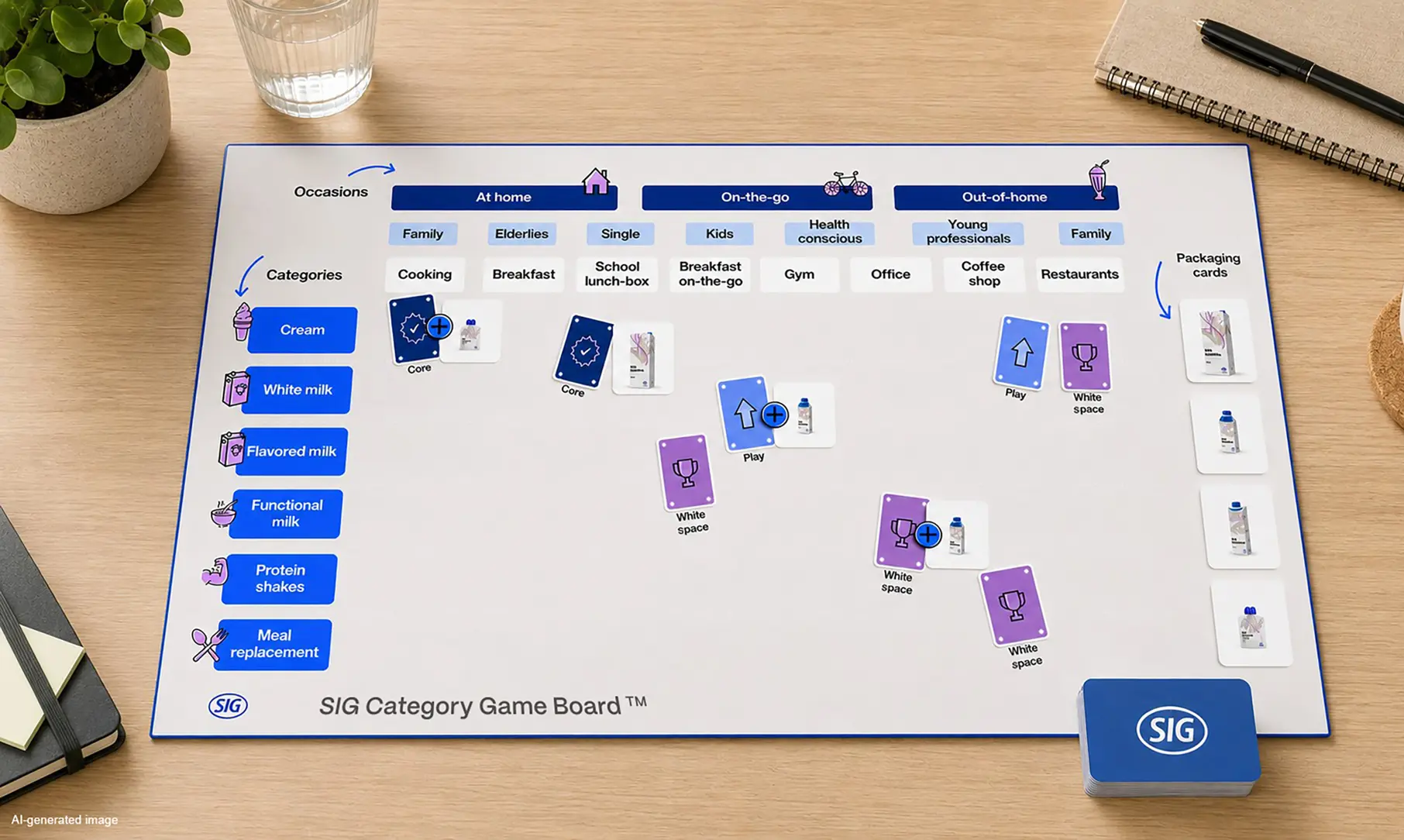
It does this by mapping four core dimensions:
- Categories – what a brand sells
For example: white milk, flavored milk, plant-based drinks, culinary cream, sweetened condensed milk, ice cream mix, yogurt drinks, cheese spread, desserts, and beyond - Occasions – when and where a product is consumed
At home, on the go, at work, on premise in foodservice, or via home delivery/take away - Target groups – who the product is for (e.g. families, children, active consumers, foodservice operators)
- Channels – where the product is bought, served or consumed
At home, at school, in the office, at a restaurant, convenience stores etc.. - Packaging and technology solutions – how is it made possible
For example, using aseptic cartons, spouted pouches, or bag in box to make a specific category–occasion–channel combination technically and economically viable.
By plotting existing SKUs across these dimensions, manufacturers can instantly see which "cards" on the board are already played – and which cards are sill to be laid out.
Why this matters specifically for aseptic
F&B growth typically comes from three types of moves:
- Expanding into new use occasions – for example, taking a core product from at home usage into on-the-go or at work consumption
- Expanding into adjacent or new categories – for instance, from white milk into flavored milks, functional shots, or culinary bases
The Game Board makes these options tangible and helps teams ask: If we have aseptic capability – in carton, pouch, or BIB – where else could we credibly play? In many cases, the barrier to entry is not consumer demand, but the absence of a suitable packaging and system solution.
Overlaying SIG’s aseptic portfolio onto the Game Board allows manufacturers to see:
- Which white spaces become attractive once ambient, shelf stable formats are on the table
- Where new packaging substrates (like aseptic spouted pouches or BIB) unlock on the go, snacking, or foodservice opportunities that chilled formats cannot reach efficiently
- How to balance defensive, core business with offensive, packaging led innovation in a structured way
A simple, repeatable method to spot white spaces
SIG recommends a six-step approach to applying the SIG Category Game Board™:
- Define the playing field
Agree which categories, occasions, target groups and channels are in scope. Establish a common taxonomy so everyone speaks the same language - Plot today’s portfolio
Map all current products onto the board. Mark where the brand is strong (core) and where it already plays. This creates a fact-based starting point - Identify white spaces
Highlight attractive but empty combinations – channel gaps, untapped occasions, adjacent categories, new/additional target groups or packaging options (for example, moving from chilled to ambient via aseptic) - Generate initiatives
For each priority white space, develop two to three initial concepts – new products, line extensions, or pack / format innovations, often in combination - Evaluate and prioritize
Assess each concept on strategic fit, consumer value, feasibility, and speed to market. Align on a focused roadmap. - Learn, scale, and update
Launch pilots, track KPIs, scale what works, and regularly refresh the board. Over time, more “squares” become occupied as white spaces turn into real businesses.
In this way, aseptic capabilities stop being a purely technical asset and become a strategic growth engine.
Collaboration as the next frontier of F&B innovation
Looking ahead, the next phase of F&B innovation will depend not only on technology, but on tighter collaboration between producers, retailers, and aseptic solutions provider.
"When product development, packaging, and equipment come together earlier in the process, the outcomes are stronger and more scalable. That’s how the industry gets to solutions that work long term – for people, for markets, and for the planet."
As dairy and the broader F&B sector continue to evolve, system level packaging – especially aseptic packaging – is set to play an increasingly influential role. With its expanding portfolio and longstanding expertise in aseptic cartons, spouted pouches, and bag in box, SIG is positioned to remain a key partner for manufacturers who see aseptic not just as a pack choice, but as a way to unlock new products, new occasions, new channels – and new white spaces for sustainable, profitable growth.