Why aseptic packaging is becoming a strategic growth lever for food brands
Food and beverage manufacturers are being asked to deliver more than ever before. Consumers want products that are natural, convenient, high quality, and more sustainable. At the same time, producers are navigating rising costs, more complex supply chains, and increasing pressure to reduce waste and environmental impact.
Rana Baydoun-Reckart is Global Senior Channel & Ecosystem Manager at SIG, where she works at the intersection of innovation, technology, and commercialization. She helps companies translate consumer trends into market-ready solutions. Rana collaborates with startups, ingredient suppliers, technology partners, and industry stakeholders to build innovation ecosystems that accelerate the development and commercialization of next-generation food and beverage products.

Aseptic packaging is emerging as one of the most effective ways to meet all of these expectations at once. It enables safe, premium-quality food and beverage products with extended shelf life — without the need for refrigeration or preservatives.
Why aseptic matters now
The industry is at a turning point. Traditional trade-offs between shelf life, product quality, operational efficiency, and sustainability are no longer acceptable.
"Brands need solutions that help them protect product integrity while also improving agility and resilience across the supply chain."
Aseptic technology addresses exactly this challenge by allowing products to remain safe and stable for up to 12 months at ambient conditions, reducing dependence on cold-chain logistics and helping products travel further while maintaining quality.
From a business perspective, that changes the game. Longer shelf life creates more flexibility in distribution, lowers the risk of spoilage, and opens access to new markets and channels. From a consumer perspective, it supports expectations around convenience, availability, and product quality. And from a sustainability perspective, it contributes to lower waste and reduced transport-related emissions by enabling ambient distribution.
Preserving what matters most
One of the greatest strengths of aseptic packaging is its ability to preserve the characteristics consumers value most in food and beverage products. This includes taste, texture, color, and nutritional value. In a market where clean-label and minimally processed products are increasingly important, that matters more than ever. Aseptic technology supports formulations made with natural ingredients while maintaining the quality consumers expect on the shelf and at the moment of consumption.

"This is not simply about extending shelf life. It is about preserving product value through the whole journey — from production and distribution to retail and final consumption. When manufacturers can protect sensory quality and nutritional integrity without relying on preservatives or refrigeration, they create a stronger proposition for both customers and consumers."
Efficiency and flexibility for manufacturers
Operationally, aseptic systems offer significant advantages. By removing the need for cold-chain logistics, manufacturers can simplify distribution and potentially reduce associated costs. At the same time, production systems designed for rapid format and product changeovers can support faster manufacturing, reduced waste, and better responsiveness to changing demand patterns.
That flexibility is increasingly important in a market shaped by shorter innovation cycles and more fragmented consumer demand. Producers need systems that can handle multi-product, high-volume production while remaining adaptable enough to support new categories, new formats, and new consumption occasions. Aseptic technology is not just a packaging solution in this context — it is a platform that supports growth, scale, and future readiness.
Built for today’s consumer expectations
Consumer expectations are redefining packaging performance. Today’s shoppers are looking for products that feel fresher, more natural, and easier to use — and they are also more conscious of sustainability. Aseptic packaging aligns strongly with these expectations. It enables clean-label products, helps retain nutritional quality through minimal processing, supports convenient consumption formats, and contributes to more sustainable packaging choices.

For brands, this creates an opportunity to innovate with confidence. It becomes possible to develop products that are not only shelf-stable, but also premium in quality perception and aligned with evolving lifestyle needs. Whether the goal is on-the-go convenience, pantry-friendly storage, or differentiation through ingredients and texture, aseptic packaging expands what is possible.
Unlocking product innovation — from smooth to chunky
Another major advantage of modern aseptic systems is formulation flexibility. Innovation today is moving well beyond conventional liquid products. Manufacturers are increasingly exploring recipes that include particulates, fibers, grains, purées, and more complex textures. SIG’s aseptic capabilities are designed to support exactly this type of development. Food products with particulates can include pieces up to 25 mm, fiber lengths up to 40 mm, and solid content up to 50%. For beverages, SIG Drinksplus technology supports chunky ingredients up to 10%, particulates up to 6 mm, fibers up to 1 x 15 mm, and viscosities up to 3,500 mPas.
This opens the door to more differentiated food and drink experiences — from indulgent textures to functional ingredients and premium sensory appeal.
"In practical terms, it means manufacturers do not need to choose between shelf life and creativity. They can deliver products with real ingredients, richer mouthfeel, and stronger shelf presence while maintaining the commercial advantages of aseptic distribution."
A comprehensive packaging ecosystem
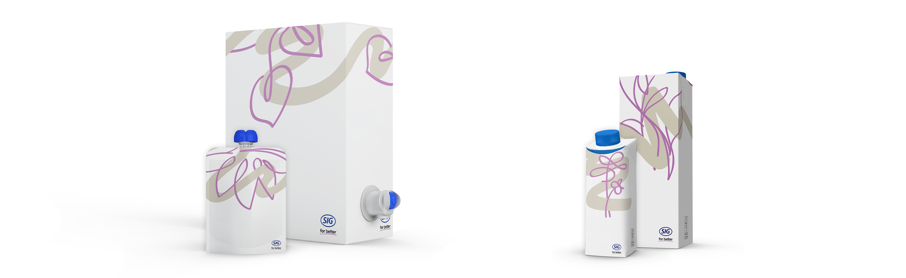
Aseptic success is not only about the pack itself. It depends on the performance of the full system — filling technology, technical service, digital support, and packaging expertise working together. SIG provides complete packaging systems and is the only company delivering aseptic solutions across three key packaging types: carton, bag-in-box, and spouted pouch. This breadth gives manufacturers the flexibility to choose the right solution for different products, consumption occasions, and distribution channels.

That end-to-end model matters because today’s food and beverage producers are not just buying packaging; they are investing in reliability, scalability, and innovation capability. The companies that succeed will be those that can adapt quickly without compromising food safety, quality, or operational performance. Aseptic technology provides the infrastructure to do exactly that.
The path forward
The future of food will depend on solutions that do more across the entire value chain. Manufacturers need packaging that protects quality, supports efficiency, reduces waste, and helps them respond to shifting market expectations swiftly. Aseptic packaging is uniquely positioned to deliver on all four fronts. It is not a niche technology for specific products; it is a strategic enabler for growth.
At SIG, we see aseptic not simply as a method of preserving food, but as a way to unlock greater value from every product — for brands, for retailers, for consumers, and for the planet. When applied thoughtfully, it allows manufacturers to go beyond shelf life and rethink what is possible in product quality, innovation, sustainability, and market reach. That is why aseptic continues to be one of the most powerful tools available to food and beverage businesses today.
- Bag-in-boxCartonSpouted pouch
- BeverageDairy & plant-basedFood
- July 06, 2026

Successful sustainable packaging connects environmental benefits with personal wellness

China’s fresh-made tea goes global: Key 2026 trends reshaping the international beverage market