Food safety and preservation – why it matters and how food actually spoils
Why does food spoil – and how can aseptic technology help prevent it? In the latest episode of “Aseptic. Engineered. The SIG Expert Series”, Kai Wittkowski, Global Quality Leader for Food & Product Safety Compliance at SIG, explains why food preservation is such a crucial topic, what can cause food to spoil, and how aseptic technology helps protect the value of food from production to consumption.
Kai Wittkowski is the Global Quality Leader for Food & Product Safety Compliance at SIG. He joined SIG in 2018, bringing with him a degree in food engineering and extensive experience across the food industry. Based in Linnich, Germany, Kai and his team collaborate daily with colleagues worldwide to ensure consumers can enjoy SIG-packed products without worrying about how those products are made safe. They can simply focus on enjoying their next sip. Kai particularly appreciates how his role brings together food, science, technology, and, most importantly, people. He likes to see the big picture, understanding how value is created at SIG from start to finish - from suppliers and product development to production and ultimately, customers and consumers.

Kai, you are a food engineer. What does that involve?
A food engineer deals with food production technologies – from traditional methods such as cooking or fermenting to modern processes such as UHT treatment and aseptic processing. I describe it as being “ a bit like a cook, but with an industrial and scientific background.”
Food engineering sits at the intersection of microbiology, chemistry, process engineering, sensory science, and other disciplines. At SIG, my role is to help ensure that packaging systems – and therefore customers’ products – comply with international food legislation and standards.
Why is food safety and preservation such a crucial topic?
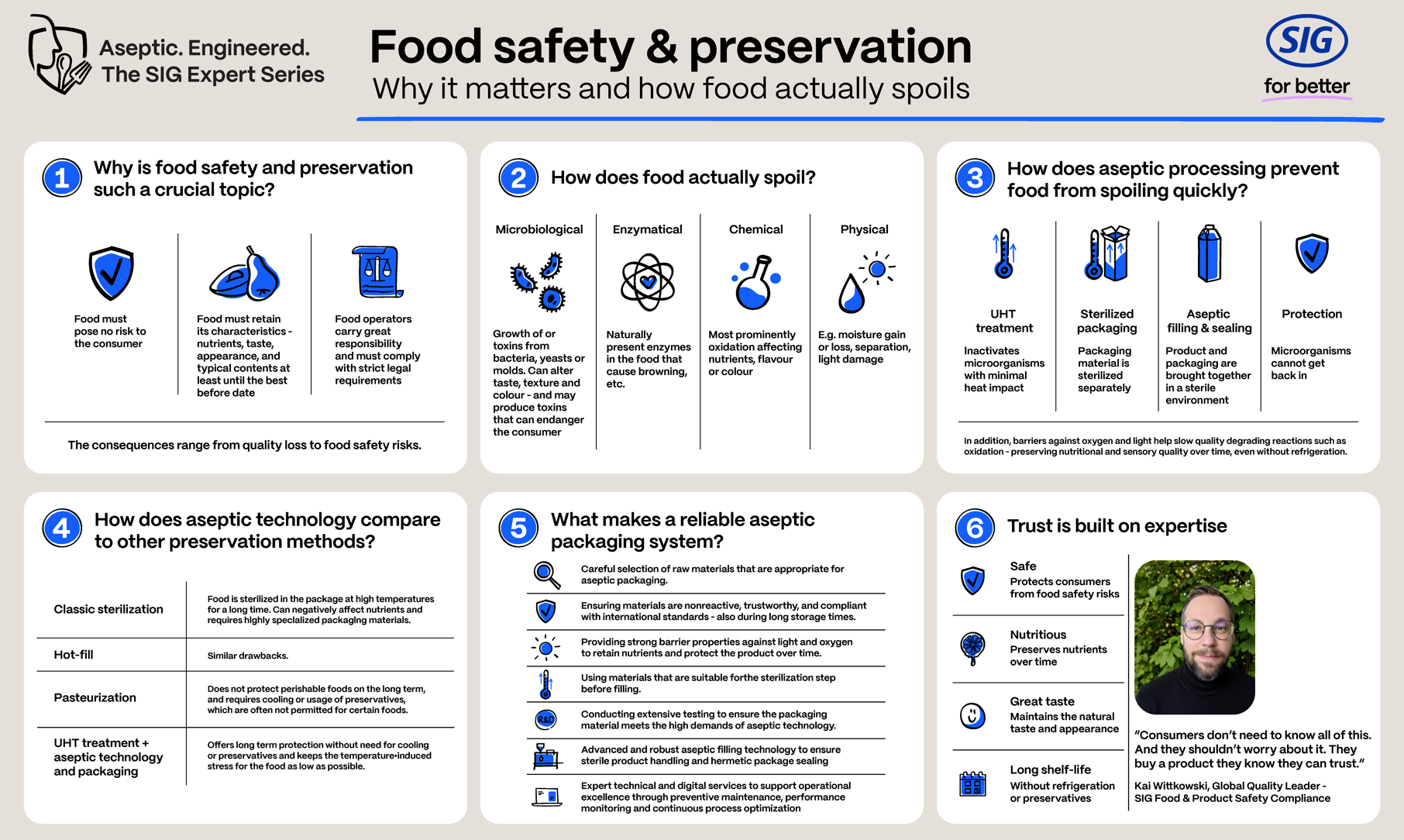
Food is valuable because it affects all of us – and it is also very sensitive. If not protected properly, it can spoil in several different ways. Microbiological spoilage can be caused by the growth of bacteria, yeasts, or molds. Enzymatic spoilage may occur through naturally present enzymes in the food, causing browning, for example. Chemical spoilage is often linked to oxidation, which can affect color, flavor, and nutrients. Physical spoilage can be caused by factors such as light exposure, water loss, or separation.
The consequences range from quality loss to food safety risks. This is why food producers carry great responsibility and must comply with strict legal requirements. Two basic principles are particularly important: food must pose no risk to consumers, and it should retain its typical characteristics – such as taste, nutrients, appearance, and contents – at least until the end of its best-before date.
How does aseptic processing prevent food from spoiling quickly?
Aseptic processing and packaging address one of the main causes of spoilage: microorganisms. First, the product is heat treated – typically through UHT treatment – to inactivate microorganisms with minimal heat impact. The packaging material is sterilized separately. Then the sterile product and sterile packaging are brought together during filling and sealing in a sterile environment, so microorganisms cannot get back in.
In addition, packaging with strong barrier properties can help slow quality-degrading reactions, such as oxidation caused by oxygen or light. This helps preserve nutritional and sensory quality over time – even without refrigeration.
Why do you see aseptic technology as the best overall solution?
For me, aseptic processing combined with aseptic packaging is the best-balanced combination of safety and quality for perishable food. It enables long shelf life without the need for refrigeration or preservatives, while keeping heat-induced stress on the food as low as possible.
Compared with classic sterilization, where food is sterilized inside the package at high temperatures for a longer time, aseptic processing uses a more targeted heat treatment before filling. This can help better protect taste, nutrients, and color. Non-aseptic filling, by contrast, does not provide the same long-term protection for perishable foods and usually requires refrigeration or preservatives – which are not always permitted or desired.
What does it take to provide a reliable aseptic packaging system?
A reliable aseptic packaging system starts with careful selection of raw materials. They must be suitable for aseptic packaging, compliant with international standards, and appropriate for long storage times. They also need to be nonreactive, suitable for sterilization before filling, and able to provide barrier properties against factors such as oxygen and light.
Beyond material selection, extensive laboratory testing is needed to ensure that packaging material meets the high demands of aseptic technology. Consumers do not need to know all of this – and they should not need to worry about it. They buy a product they know they can trust. That trust is built on the care, expertise, and engineering behind every reliable packaging system.
Infographic: food safety and preservation in a nutshell
About “Aseptic. Engineered. The SIG Expert Series”
The series combines expert video interviews and infographics to explain what aseptic processing and packaging means, how it works, and why it matters for consumers, manufacturers, and retailers. Each episode highlights the knowledge, engineering, and dedication behind SIG’s aseptic solutions.
- novembre 11, 2026

Introducing “Aseptic. Engineered. The SIG Expert Series” on safe, high-quality food packaging

Successful sustainable packaging connects environmental benefits with personal wellness